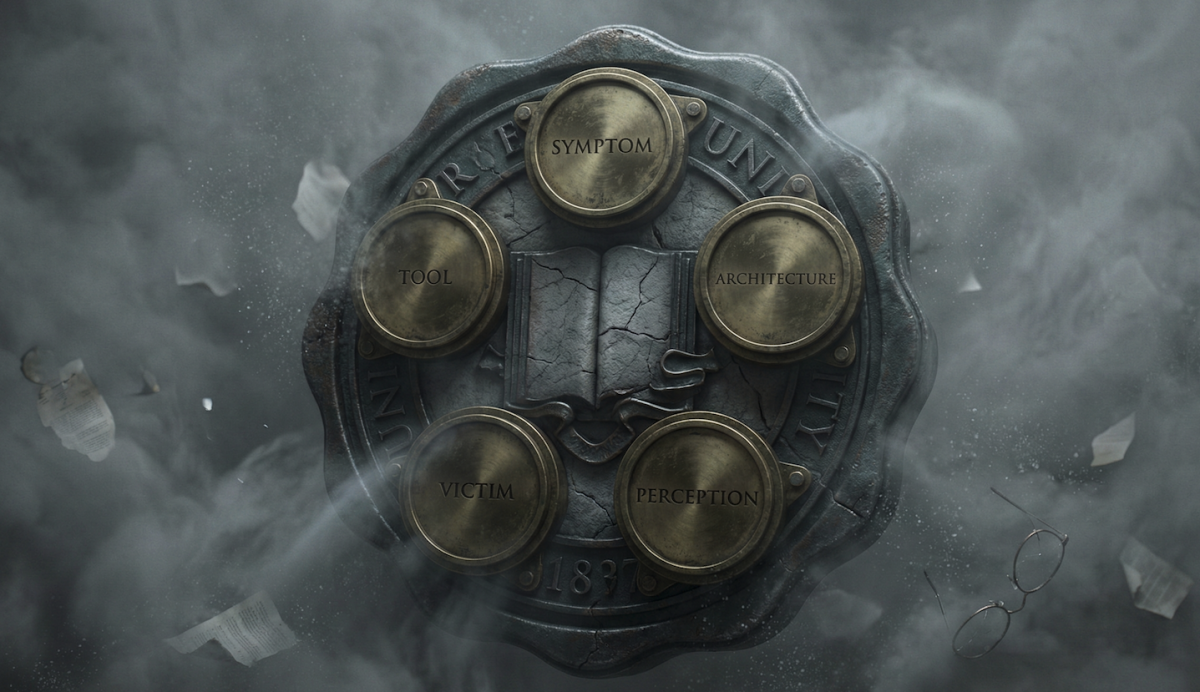
There is a powerful sense of déjà vu that haunts the halls of higher education. We are, by any measure, in a state of perpetual, frantic activity. Our calendars are brutalist monuments to back-to-back meetings. We convene summits on AI, task forces on funding, committees on public trust, and working groups on relevance. We produce strategic plans thick enough to stop a bullet, and we issue press releases that glow with the language of innovation and transformation.
And yet, we are in a fog.
For all our motion, we feel a profound stasis. We are busy, but we are not moving. The same crises—funding, technology, identity, value—reappear with the comforting regularity of the academic year, each time discussed as if they were entirely new. This is the “procedural theatre” of the modern university: a performance of crisis management so polished, so well-rehearsed, that we have forgotten it is a performance.
The reason for this paralysis is not a lack of effort, talent, or good intentions. Our universities are filled with brilliant people working tirelessly to solve our problems.
The reason is a fundamental crisis of perception.
We are trying to navigate a new and treacherous landscape using a map that is dangerously, systemically wrong. The contemporary discourse on higher education is trapped by five pervasive blind spots. These are not simple errors. They are sophisticated, interlocking defence mechanisms that, in their entirety, serve to protect the institution from the one thing it needs most: fundamental change.
These blind spots cause us to mistake symptoms for diseases, tools for neutral agents, and nostalgia for rigor. They prevent us from seeing, let alone solving, the true, architectural crises facing the university.
This article will not offer another five-point plan. The last thing we need is another plan. It will, instead, illuminate these five blind spots, not as a polemic, but as a diagnostic lens. The goal is to provide a new way for leaders, academics, and policymakers to see their institutions—and their own strategic choices—more clearly. It is time to step out of the fog.
Blind Spot 1: The Symptom/System Fallacy
Mistaking the fever for the infection.
We have, as a sector, become world-class experts at identifying and reacting to acute symptoms. We are, however, blissfully blind to the chronic systemic diseases that cause them. Our entire leadership model has become a form of institutional “patch management,” a frantic game of whack-a-mole that leaves the broken underlying system not only untouched but unexamined.
The most perfect, and most humiliating, example is the “AI Cheating Crisis.”
The moment ChatGPT arrived, the institution went into a full-blown moral panic. The symptom—plagiarism—was immediately identified. We declared an arms race, investing millions more in the surveillance software (our “AI”) to fight the students’ “AI” (their new, better ghostwriter).
This is a profound failure of imagination. The “crisis” is not that students can now use a machine to write a passable essay. The crisis is that, for decades, we have been running a pedagogical and assessment model that rewards the kind of superficial, reproducible, formulaic work that a machine can now automate.
AI is not the disease. AI is the unforgiving diagnostic tool that has revealed the pre-existing condition.
The Kenyan ghostwriter, the file-sharing website, the “essay mill”—these were all prior symptoms of the same disease. We ignored them. But AI scaled the problem to a size our institutional immune system could no longer ignore, and we mistook the diagnostic tool for the illness.
If a student can “cheat” on your final exam by actually learning how to use the single most powerful productivity tool of the next century, who, exactly, is failing whom?
The true disease is a decades-old assessment philosophy that, for reasons of scale, cost, and simple inertia, has clung to text-based proxies of learning instead of demanding dynamic, AI-resistant demonstrations of knowledge. We have been assessing the artifact, not the intellect. The machine has now mastered the artifact.
The Consequence: By obsessively focusing on the symptom (plagiarism), we waste our energy, budget, and moral authority on a self-defeating “war on cheating.” We are trying to police a tool rather than redesign our pedagogy. We are building a taller fence when the real problem is that the “treasure” we’re guarding has already lost much of its value. We are treating the fever, while the infection of our unexamined assessment model metastasizes.
Blind Spot 2: The Illusion of the Neutral Tool
When the scoreboard designs the game.
Our second blind spot is a form of calculated naivety. We consistently treat new technologies, metrics, and policies as neutral, technocratic instruments for achieving rational goals. We are blind, or pretend to be, to their nature as active agents of power.
A tool is never “just” a tool. A tool is a Trojan Horse that carries an army of embedded values, hidden logics, and new forms of gravity. A tool is a philosophy, and the moment we adopt it, we are, in some part, adopting its philosophy.
When we adopt a global ranking system to “benchmark our performance,” we are not just using a tool. We are importing its definition of “excellence.” We are agreeing, implicitly, that “prestige” is a function of endowment, citation counts, and acceptance rates. Soon, this “neutral” tool is no longer a tool at all; it is the scoreboard. And the first rule of any institution is that the game is always played to the scoreboard.
Our metrics are not passive observers; they are active architects. They are designing the game.
Consider the proposed South African Central Application Service (CAS) bill. On the surface, its advocates present it as a neutral tool for “efficiency” and “fairness”—a simple spreadsheet to streamline a messy process. But as our analysis revealed, this is a profound illusion.
A CAS is not a spreadsheet. It is a potential political weapon. It is a mechanism for “flattening” institutional identity, for making unique universities legible (and thus interchangeable) to a central algorithm. It is a way to centralize control over the entire national talent pipeline, shifting power from the universities to the state. It is an architecture of control disguised as an instrument of service.
The Consequence: By pretending our tools are neutral, we inadvertently cede our institutional sovereignty. Our mission, our values, our very identity are silently and relentlessly rewritten by the logic of the instruments we adopt. We do not choose to prioritize citation metrics over pedagogical innovation; our “neutral” ranking and tenure tools make the choice for us. We are, in effect, allowing our institutions to be hijacked by their own dashboards.
Blind Spot 3: The Architectural Blind Spot
Redecorating a condemned building.
Our institutional discourse is obsessively focused on the contents of the university. We argue, endlessly and passionately, about the curriculum, the reading lists, staff diversity, and specific research topics. We are, by contrast, structurally blind to the container—the fundamental architecture of the institution itself.
The university’s true power, its “deep state,” lies not in its syllabus, but in its architecture: its calendars, its governance models, its tenure codes, its funding flows, and its incentive structures. And we almost never talk about that.
We are masters of redecorating a room, while cheerfully ignoring the fact that we are in a condemned building.
The most potent example of this blind spot is the institutional co-option of the “decolonisation” debate. This was, and is, a vital and necessary challenge, an “irritation” from the environment demanding a fundamental re-architecture of knowledge and power.
How did the system respond?
It metabolized this radical challenge into a safe, manageable, and entirely superficial project of redecorating the content. We add a new reading to the syllabus. We establish a committee to rename a building. We hold a workshop. We perform, with great solemnity, the appearance of transformation.
We do this precisely to avoid confronting the terrifying, expensive, and difficult reality: that true decolonisation would mean demolishing and rebuilding the container itself. It would mean confronting the colonial architecture of our peer-review pipelines, our definitions of “scholarly output,” our tenure metrics that punish public-facing work, and our governance structures that centralize power.
The Consequence: We create a powerful and cynical illusion of radical transformation, all while leaving the core structures of inequality, irrelevance, and coloniality firmly in place. This “architectural blind spot” is the system’s most effective defence mechanism. It focuses our critical energy on the cosmetic (the content) so we have no energy left to attack the structural (the container).
Blind Spot 4: The Victim Narrative
The strategic comfort of crisis.
Our fourth blind spot is not an analytical error but a psychological one. We have become deeply, perhaps terminally, attached to a narrative that frames the university as a noble, passive victim of savage external forces.
In this comforting morality play, we are the besieged sanctuary of truth, and the barbarians are at the gates: populist politicians, “neoliberal” market logic, philistine budget cuts, a skeptical public. This narrative is comforting because it absolves us of our own agency and, more importantly, our own strategic complicity in creating our predicaments.
The funding crises in Atlantic Canada and the United Kingdom are a perfect case study. The simple, “victim” narrative blames a sudden, cruel government policy—a visa cap, a fee freeze. The barbarians\!
The more difficult and less comfortable truth is that these crises were not sudden. They were the inevitable and predictable result of the universities’ own prior, high-risk strategic choices. For over a decade, institutions in these regions chose to use volatile international tuition fees as a financial life-support system to mask the chronic, underlying disease of domestic underfunding and demographic decline.
This was not a strategy for sustainable growth; it was a high-risk dependency. This wasn’t a sudden storm that appeared from nowhere; it was the iceberg we had been steering directly towards for ten years, all while congratulating ourselves on the record-breaking profits from our first-class deck.
When the inevitable policy shift came, we framed it as a “betrayal.” A more honest word would be “consequence.”
The Consequence: This victim narrative is perhaps the most dangerous blind spot of all. It creates a culture of learned helplessness and defensive reactivity. It stops us from asking the hard, self-critical questions that are the necessary prerequisite for genuine strategic change. We have traded the burden of leadership for the comfort of complaint.
Blind Spot 5: The Nostalgia Trap
The future is not behind us.
The final blind spot is our institutional reflex in the face of true disruption. When a new force—like AI—arrives and invalidates a core practice, our instinct is not to innovate, but to retreat. We mistake the comfort of the familiar for the rigor of the past.
The global response to AI’s assault on the traditional essay has been a case in point. The most “serious” proposals from faculty senates around the world have been, overwhelmingly, a call to go “back”: back to in-class, handwritten essays; back to closed-book exams; back to oral defences for every student.
This is not a strategy. It is a retreat. It is a “failure of imagination,” as one of our insights files put it, “a retreat masquerading as rigor.”
It is an attempt to build a fragile, artificial, analogue bubble where the new reality cannot enter. It is, in effect, an attempt to solve the problem of the future by retreating to the past.
We are proposing to “prepare” our students for an AI-abundant, globally-connected, digitally-native world by… locking them in a room, taking away their tools, and forcing them to write with a pen.
The absurdity is breathtaking. Our core duty is to prepare students for their future, not our past. This nostalgic reflex is a profound dereliction of that duty. We are, in effect, planning to graduate students who are perfectly prepared for the world of 1995.
The Consequence: By clinging to a past that no longer exists, we make ourselves irrelevant. We waste our energy defending old methods instead of inventing new ones. We fail our students by “protecting” them from the very world we are supposed to be preparing them for.
The Unifying Theory: The University Talking to Itself
These five blind spots are not separate, isolated errors. They are the interlocking, self-sustaining, and highly successful defence mechanisms of a system that is designed for one primary purpose: its own stability.
In the language of social systems, the university is a “self-referential” or “autopoietic” system. Its primary, structural goal is not, in fact, to “serve the public,” “discover truth,” or “educate the youth.” Its primary goal is to continue being itself.
When you understand this, the blind spots snap into focus as a perfectly logical, interlocking system:
The Victim Narrative (Blind Spot 4) provides the moral justification for the Nostalgia Trap (Blind Spot 5)—we are retreating to the past not because we are afraid, but because our “noble” methods are under attack.
The Symptom/System Fallacy (Blind Spot 1) is the operational engine that is made possible by the Architectural Blind Spot (Blind Spot 3)—we can only focus on symptoms because we are blind to the underlying architecture.
And the Illusion of the Neutral Tool (Blind Spot 2) is the mechanism that allows the system to absorb, and be changed by, its environment without ever having to admit that it is changing.
The result is a university that has become incredibly, disastrously expert at managing the discourse about its own crisis, while being structurally incapable of solving it. It is trapped in a sophisticated, self-sustaining, and perfectly closed loop of performative inaction.
We are in a fog because we are inside a system that is, by design, talking to itself.
The Conclusion: From Blind Spots to Blueprints
The antidote to these blind spots is not another five-point plan. It is not a new committee. The antidote is a new set of institutional habits built around asking better, more courageous, second-order questions.
We need, in short, a new “meta-structural literacy” among university leaders.
The only way to escape a closed loop is to become aware of the loop itself. We must be willing to use these blind spots as a diagnostic lens in our next strategic meeting.
We must stop, and when a colleague says, “We have an AI cheating problem,” we must have the courage to ask:
“Are we sure? Or does AI’s power reveal a
pre-existing weakness in our assessment philosophy that we’ve ignored for twenty years?”
When a colleague says, “We must find a way to better communicate our value to the government,” we must have the courage to ask:
“Or, what strategic choices did we make over the last decade that caused the public and the government to feel, rightly or wrongly, that we stopped serving their interests?”
And when a colleague says, “We need to add a new module on X to the curriculum,” we must have the courage to ask:
“Or, is the 18-month, 12-committee architecture of our curriculum development process so fundamentally broken that by the time we approve the module, it’s already irrelevant?”
These are the right questions. They are hard questions. They are structural, not superficial. They are uncomfortable because they challenge our own complicity.
The task of leadership is no longer to be the most efficient manager of the university as it is. The task is to become the chief architect of the university as it must be. It is time to step out of the fog, not by finding new answers to the old questions, but by finding the courage to ask the ones that matter.
—
#re_v5