This article first appeared on University World News
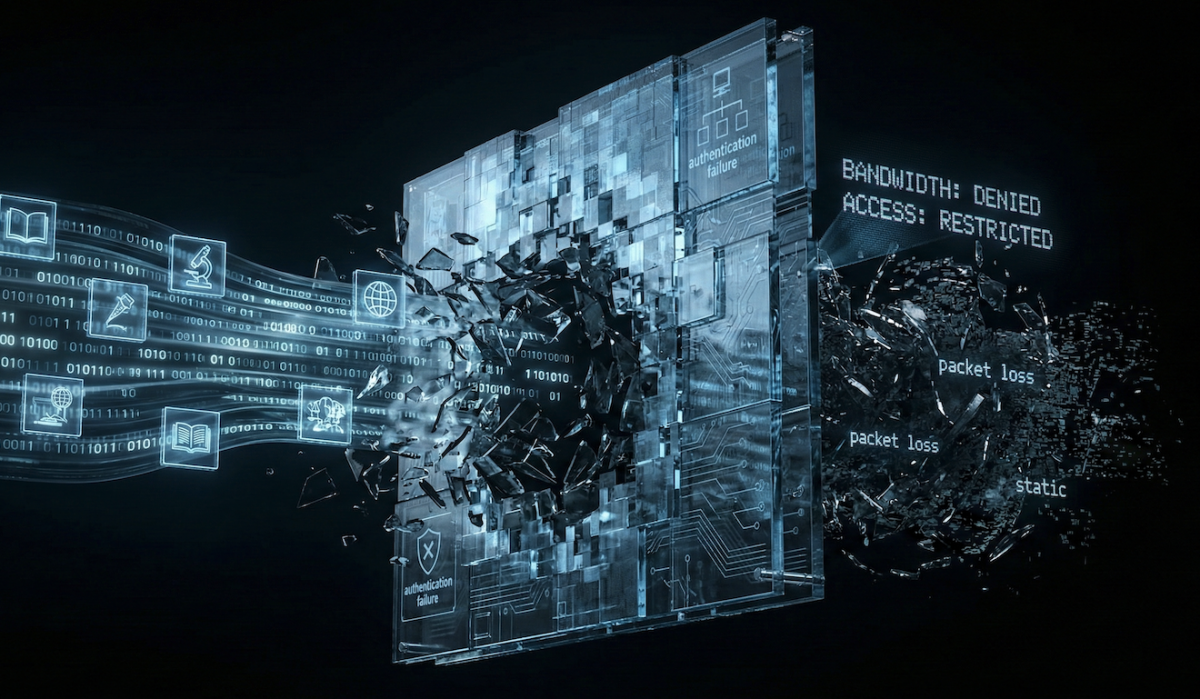
We used to imagine isolation through geography: a university at the end of a long road, a library without the book you need, a lab without the reagent that arrived but never cleared customs. Today, isolation has a different shape. It is measured in milliseconds, in packet loss, in passwords that never authenticate, and in video calls that freeze at the exact moment someone asks a question that matters.
The digital divide is not a matter of inconvenience; it is the quieting of a continent in the conversation that defines contemporary knowledge. Call it a digital iron curtain if you like. It falls without making a sound.
A university is, among other things, a conversation extended through time. It reproduces itself by exchanging communications: papers, datasets, code, peer review, lectures and criticism. Cut or throttle the lines that carry these exchanges, and the system does not simply slow; it begins to misrecognise itself. What looks like a campus remains a campus but, increasingly, it participates in an internal monologue while the world moves on.
The signs say ‘Connected’, the reality is ‘connected-ish’, and our brightest scholars become expert schedulers of when the Wi-Fi is most likely to behave. We have mastered the asynchronous seminar: professor in week one, slides in week four, and bandwidth in week nine.
Conspiring layers
It helps to name the layers of the problem because they conspire. There is the physical layer – power that flickers, fibre that stops at the city’s wealthier districts, campus Wi-Fi that covers lawns better than laboratories, international transit billed as if it were a luxury good. There is an institutional layer – identity systems that do not interoperate, paywalls policed by subscriptions we cannot afford, cloud contracts whose egress fees turn data into a hostage.
And there is the epistemic layer: corpora in languages we did not train, datasets about us governed elsewhere, standards written far away that decide what counts as ‘real’ science. Add them together, and you produce an invisibility tax. The work gets done more slowly, the collaboration arrives later, if at all, and the citation networks (the social capital of knowledge) grow elsewhere.
Time becomes the currency most cruelly devalued under these conditions. Submission portals time out on the last page; grant platforms assume uninterrupted sessions; replication studies die because the dataset is perpetually ‘downloading’. Students learn to live in queues – queues for computers, for power sockets, for the moment when the network is rumoured to be fast.
Staff learn to teach around outages, which is another way to say they teach less. The global conversation, in contrast, runs on a clock that never apologises. Deadlines, embargoes, review windows – none of them lengthen to accommodate our buffering.
Academic freedom in cable form
We should be candid about the political economy at work. Bandwidth is rationed because it is overpriced; it is overpriced because markets are concentrated and peering is discouraged; peering is discouraged because the business model prefers toll roads to commons. The state, unsure whether universities are public goods or line items best trimmed, has not ring-fenced connectivity as it has ring-fenced salaries.
Meanwhile, the platforms we depend on are owned elsewhere and price their generosity with a lawyer’s precision. Nothing here is a conspiracy. It is simply what happens when we treat connectivity as a convenience rather than as academic freedom in cable form.
What, then, would it mean to take the digital divide seriously: as a structural threat to knowledge production, not as a customer complaint? Start with the unglamorous fact that networks are built, not wished into being. At the national scale, research and education networks must be funded and treated as critical infrastructure, with mandates to peer at internet exchange points, to negotiate sane transit, and to provide redundancy that outlasts cabinet reshuffles.
At the campus scale, connectivity should be designed around attention rather than around marketing photos: Wi-Fi where students study, fibre to the labs that run at night, power that does not require a generator to keep a dataset from drowning mid-transfer. When budgets are drafted, bandwidth should sit alongside books and microscopes, not alongside lawn maintenance.
The value of reliability
Reliability is worth more than novelty. Before we buy the next fashionable platform, mirror the basics. ArXiv, PubMed, open textbooks, core journals that allow it: bring them closer, cache them, and make them reachable when undersea cables sulk. Build identity federations and eduroam-style authentication that work across the continent, so that a student from Bobo-Dioulasso can open a laptop in Kigali and be recognised as a scholar rather than a stranger.
Negotiate as a consortium, not as isolated campuses, with cloud providers; insist on transparent pricing, data portability, and zero-cost egress for research traffic. The price of fragmentation is paid in silence.
Digital sovereignty is not a slogan if it buys us the right to do our work. Data commons matter because they change where questions can be answered. Curate domain-specific, ethically governed datasets in agriculture, health, education, climate, and multilingual corpora that reflect our linguistic realities.
Host them under frameworks that protect privacy and encourage reuse; assign persistent identifiers so they appear in the citation universe; insist that cross-border projects leave their copies here as a condition of working here. When the questions that matter can only be answered with data that live at home, scholars have a reason to stay in the conversation at home.
Social accountability
We should also redesign teaching to survive the realities we cannot yet fix. Offline-first is not a defeat; it is a pedagogy. Course packs that function without continuous connectivity, assessments that do not punish intermittent access, and feedback systems that allow tutors to draft comments for sync later can transform outages from catastrophe into annoyance.
Use artificial intelligence (AI) where it returns time to humans – clustering common errors to guide teaching, drafting feedback for refinement – without outsourcing judgment to systems that do not know our languages well enough to know when they are wrong.
None of this works if the people who run networks are treated as invisible hands. A continent that can celebrate a new laboratory but not the engineers who keep it reachable on a Thursday afternoon is performing a parable about its own priorities. Pay network staff as if uptime were a scholarly achievement, because it is.
Put service-level commitments in public: uptime, repair times, and average authentication success, so that accountability can be social as well as managerial. What we measure, we learn to care about. What we hide, we learn to endure.
Filling a cracked cistern
It is tempting to outsource the problem to the sky. Satellite constellations promise to drape connectivity over everything; one can almost see the procurement memo write itself. The promise is not false, but it is not a plan, either. Without peering, policy, and campus networks that can absorb and distribute the capacity, we will have built an expensive tap to fill a cracked cistern.
The invisible work of right-of-way, spectrum regulation and the boring enforcement of standards will decide whether we buy speed or merely rent spectacle.
The AI era sharpens the stakes. Models, compute, and critical datasets tend to cluster. If the cluster is always somewhere else, we will become a prompt economy, clever users of tools that do not know us.
If, instead, we build regional compute cooperatives attached to our research and education networks, and if we anchor data that matter here, then the gradient that now pulls talent away begins to slope in our favour. People migrate toward solvable problems. Connectivity is how problems become solvable.
Bandwidth is a right
The world is not conspiring to ignore us; it simply cannot hear us when we speak at 256 kilobits per second. The digital divide is not a buffer protecting us from distraction; it is an eraser. It scrubs out citations, weakens collaborations and makes excellence look like eccentricity because it arrives out of sync.
If we treat bandwidth as a right of research, if we build the commons that make our data hard to ignore, if we prize reliability over novelty and engineers over speeches, then the iron curtain will begin to rust.
When that happens, the signs on our campuses will tell the truth. A student will open a laptop anywhere and be recognised, not merely by the network, but by a community of practice that extends beyond the gate. A lab will upload a dataset and receive code back before the next power cut. A seminar will include the world without first rehearsing the ritual of “Can you hear me now?”
And our universities will have rejoined the conversation for which they exist – not as supplicants at the window of the network, but as authors whose sentences reach their readers before the thought grows old.